
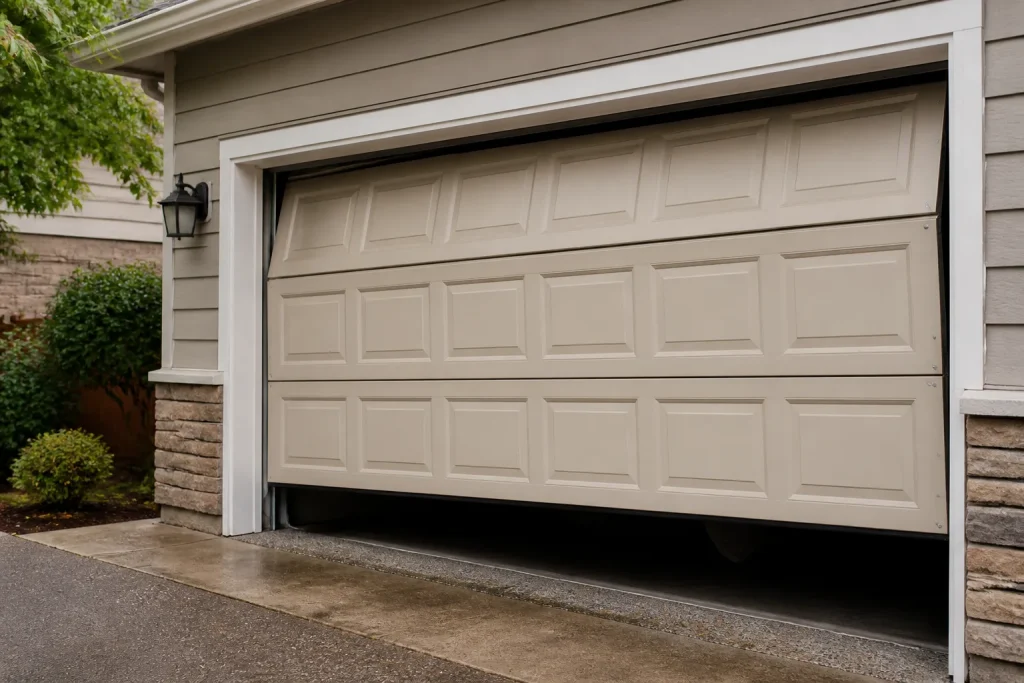
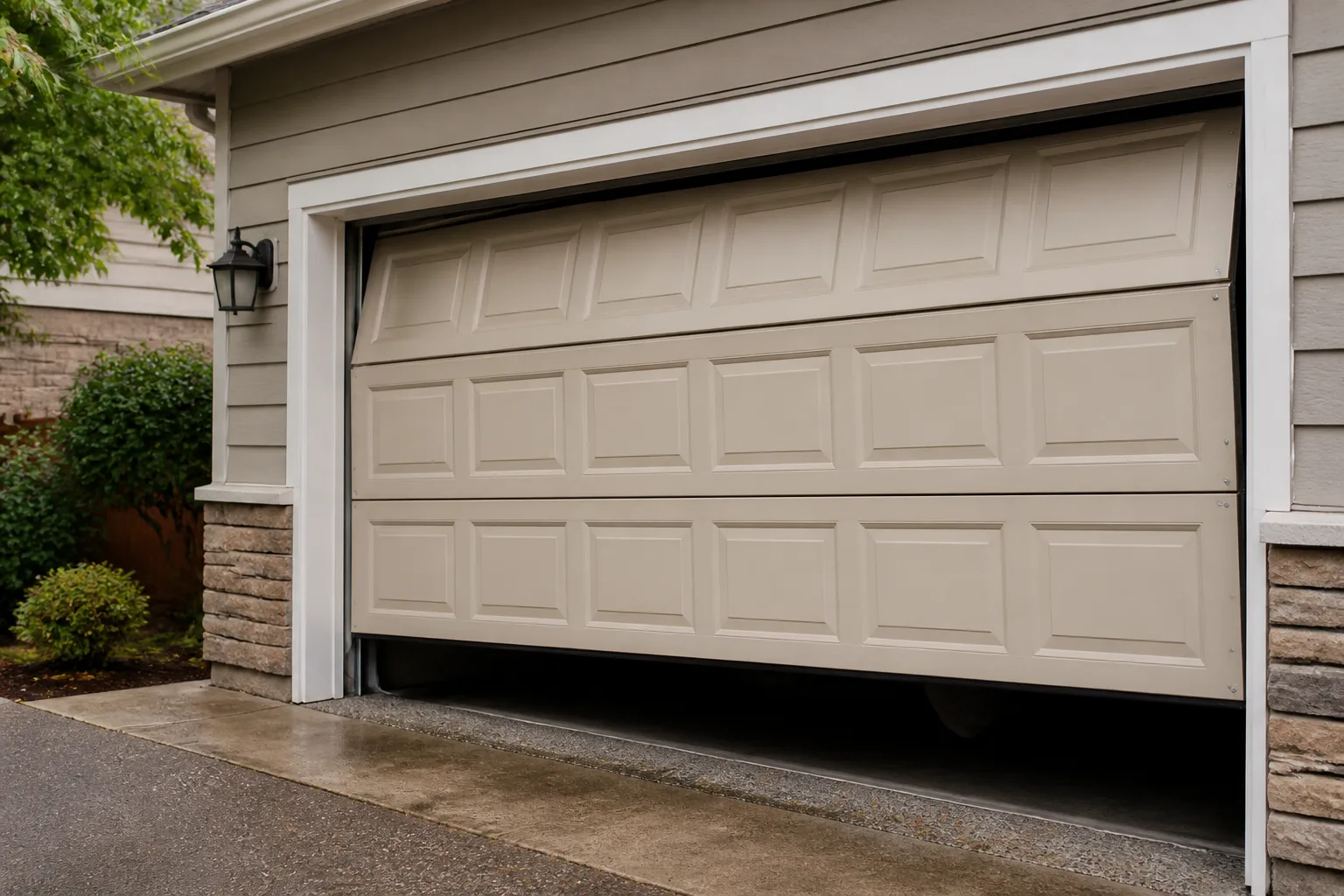
Top Signs You Need Garage Door Service – Don’t Ignore These
Most garage doors don’t fail without warning. They broadcast the problem first – a shudder, a rattle, a door that reverses a few inches off the floor – and most of us write it off as a quirk. A door that takes two seconds longer to open than it did six months ago isn’t “just slow.” It’s usually a torsion spring that’s lost tension and is forcing the opener motor to work harder than it should. Here’s what your door is actually telling you.
If you’d rather not climb a ladder to investigate, call (877) 619-3963. We answer 24/7, and fast dispatch runs from 7am to 7pm.
Key Takeaways
- A door that shudders on the way up points to a different component than one that shudders on the way down.
- Loud opener noise on a cold Burien morning is usually dry steel rollers, not a failing motor.
- A 10-second manual balance test reveals spring tension problems you can’t see.
- A frayed cable at the drum is a days-not-months warning.
- A door that reverses before the floor is a sensor issue about 40% of the time and limit-switch drift the other 60%.
What does a door that shudders on the way up versus the way down tell you?
The direction of the shudder matters. A door that shudders going up is fighting gravity and spring tension, which points to the torsion or extension springs, the cable drums, or a roller that’s binding on the track. A door that shudders coming down is a different diagnosis entirely – usually a bent track section, a worn hinge, or a roller that’s come loose from its bracket.
Here’s how the cause-and-effect chain works:
- Upward shudder: the springs aren’t carrying their share of the door’s weight, so the opener is doing more work than it was designed to do. That’s why upward shudders often lead to opener motor failure months later.
- Downward shudder: the door is binding mechanically as it descends – a track that’s been nudged out of alignment, or a roller that’s worn flat and no longer rolls cleanly.
- A shudder that gets worse over weeks: the component isn’t adjusting itself. It’s degrading.
In our experience across Burien, homeowners tend to notice the shudder but wait for it to “settle down.” It doesn’t. It gets worse, and the fix gets more expensive because the binding part takes the opener down with it. If the door shudders in either direction, that’s your cue to have garage door repair looked at before the opener pays the price.
Why is my opener so loud on cold Burien mornings?
Because steel rollers need lubrication, and cold weather stiffens grease that’s already thinning. When the temperature drops on a Burien morning, dry steel rollers on a dry track scrape and rumble – and it sounds like the motor is dying. It usually isn’t. The motor is fine; the rollers are the problem.
This is one of the most misdiagnosed symptoms in the trade. Homeowners hear the noise and assume the opener needs replacing, when a set of lubricated or replaced rollers would quiet it down. A few things to know:
- Nylon rollers run quieter than steel in cold weather and are a common upgrade for doors that rattle every winter.
- Grinding that continues after the door warms up is more likely a gear or bearing issue inside the opener – which is a genuine repair, not just maintenance.
- Rattling hinges and a loose chain can amplify the noise and sound like a motor problem when it’s actually hardware.
Because we work on Craftsman and LiftMaster openers regularly, we can usually tell within a minute of listening whether the noise is coming from the door mechanism or the motor itself. That distinction saves homeowners from replacing an opener that’s still got plenty of life left. If the sound has shifted from “noisy” to “grinding,” skip the guesswork and have the opener looked at: garage door opener repair.
How do I do the 10-second balance test?
Disconnect the opener and lift the door halfway by hand. A properly balanced door should stay put at the halfway point when you let go. If it drops, the springs have lost tension and the opener has been compensating. If it rises on its own, the springs are over-tensioned – also a problem.
The test takes ten seconds and reveals something no visual inspection can: whether your springs are still doing their job. The balance test is safe because you’re working with the door disconnected from the motor, not touching the springs themselves. What you should not do is try to adjust the springs yourself. Torsion springs are under extreme tension, and a slip can cause serious injury – most manufacturers explicitly warn against DIY spring work, and we don’t recommend it. That’s why we handle spring repair with proper winding bars and training. If the balance test shows a problem, have garage door spring repair checked by a trained technician.
What’s the one visual sign on a cable drum that means you have days, not months?
A frayed, bird-caged, or visibly unwinding cable at the drum. Look at the metal drum above each side of the door where the cable wraps. If the cable is bunched, kinked, or showing broken strands, that’s a cable on the edge of failure – not a maintenance item. A snapped cable can send the door crashing or leave it hanging dangerously, and it’s one of the most common reasons we get called to Burien homes on short notice.
Here’s what the drum is telling you:
- Clean, evenly wrapped cable: normal.
- Cable jumping off the drum or slack on one side: a sign the springs have lost tension and the cable is no longer under proper load.
- Frayed strands or a bird-caged cable: the cable is failing. Stop using the door.
Don’t try to rewind or replace a cable yourself – the tension in a garage door system is enough to cause serious injury. When a cable drum looks like this, it’s time to stop operating the door and get a technician out. This is the kind of repair we specialize in, and it’s the one we take most seriously.
Why does my door reverse before it hits the floor?
Two likely causes: a misaligned or dirty safety sensor, or a limit switch that’s drifted and is telling the opener the door has reached the floor when it hasn’t. In our experience, it’s a sensor issue about 40% of the time and limit-switch drift the other 60%. The good news is both are fixable, and neither is a reason to replace the door.
Here’s how to tell them apart:
- Check the sensors first. The two eyes at the bottom of the tracks should have a steady light on both sides. If one is blinking or dark, the sensor is misaligned, obstructed, or dirty. Wipe the lenses and check for anything blocking the beam.
- Listen for the click. If the sensors look clean and aligned but the door still reverses at the same low point every time, the limit switch has likely drifted and needs adjustment.
- Test with the wall control. If the door reverses when you use the wall button but not when you use the remote, that points to the sensor path rather than the switch.
A door that reverses a few inches above the floor is not a safety feature working correctly – it’s a system sending a false signal. If the sensor check doesn’t solve it, that’s the point where a technician should look at the limit switch.
When should you call a pro instead of waiting?
When the sign involves springs, cables, or a binding door that’s getting worse. Those three categories are where waiting turns a repair into a bigger job – and where DIY work becomes genuinely dangerous. Springs and cables carry enough stored tension to injure you, and a door that binds can drop the opener or the door itself. The other signs (noisy rollers, a misaligned sensor, a sticky track) are often safe to investigate yourself first.
We work on garage doors only – no HVAC, no plumbing, no general handyman work – which means every technician we connect you with is looking at door mechanism, opener, and spring failures all day. Whether your door is a Raynor or a Chamberlain system, the failure modes are familiar. Our technicians have up to 14 years of experience, and they arrive already knowing the typical problems your brand runs into. If a technician comes out, the price is quoted and agreed before any work starts, and the estimate is free.
Related services in Burien: if the sign you noticed is on the door itself, see garage door repair; if it’s the motor or remote, see garage door opener repair; if it’s a balance or tension problem, see garage door spring repair. For a full rundown of what we handle in Burien, start at Burien Garage Door Repair.
The Bottom Line
Your door is usually telling you what’s wrong before it stops working. A shudder that changes direction, a noise that only shows up on cold mornings, a balance test that fails, a frayed cable at the drum, a door that reverses a few inches off the floor – each one points to a specific component problem, and each one is cheaper to fix earlier. If you’re in Burien and need help, Burien Garage Door Repair offers free estimates – call (877) 619-3963. We answer 24/7. Fast dispatch from 7am to 7pm, Sunday through Friday (we’re closed Saturday).
Frequently Asked Questions
The earliest signs are a door that runs slower than it used to, a shudder in either direction, and louder-than-normal opener noise. Any of those three, especially if it’s getting worse over weeks, is a sign the system is working harder than it should. Call (877) 619-3963 for a free estimate if you’re not sure.
No, and we don’t recommend it. Torsion springs are under extreme tension, and a slip can cause serious injury – which is why most manufacturers and insurers warn against DIY spring work. That’s why we handle spring repair with proper winding equipment and training. Call (877) 619-3963 and we’ll take a look.
Cold weather stiffens grease on rollers and tracks, and a spring that’s lost tension makes the opener work harder – both slow the door down. It’s common on Burien mornings and not always a motor problem. If the door is also shuddering or noisy, it’s time to have it looked at. Call (877) 619-3963 for an exact quote – estimates are free.
If the door is quiet when disconnected from the opener but noisy when connected, the problem is in the door mechanism, not the motor. Grinding that continues once the door warms up points to an internal opener issue. We work on Craftsman, LiftMaster, Chamberlain, Raynor, and other major brands, so we can tell the difference quickly. Call (877) 619-3963 to book a look.
Written by the team at Burien Garage Door Repair.
Need Garage Door Help?
Call Burien Garage Door Repair - the local pro we connect you with is licensed and insured, here with fast help in Burien.
(877) 619-3963